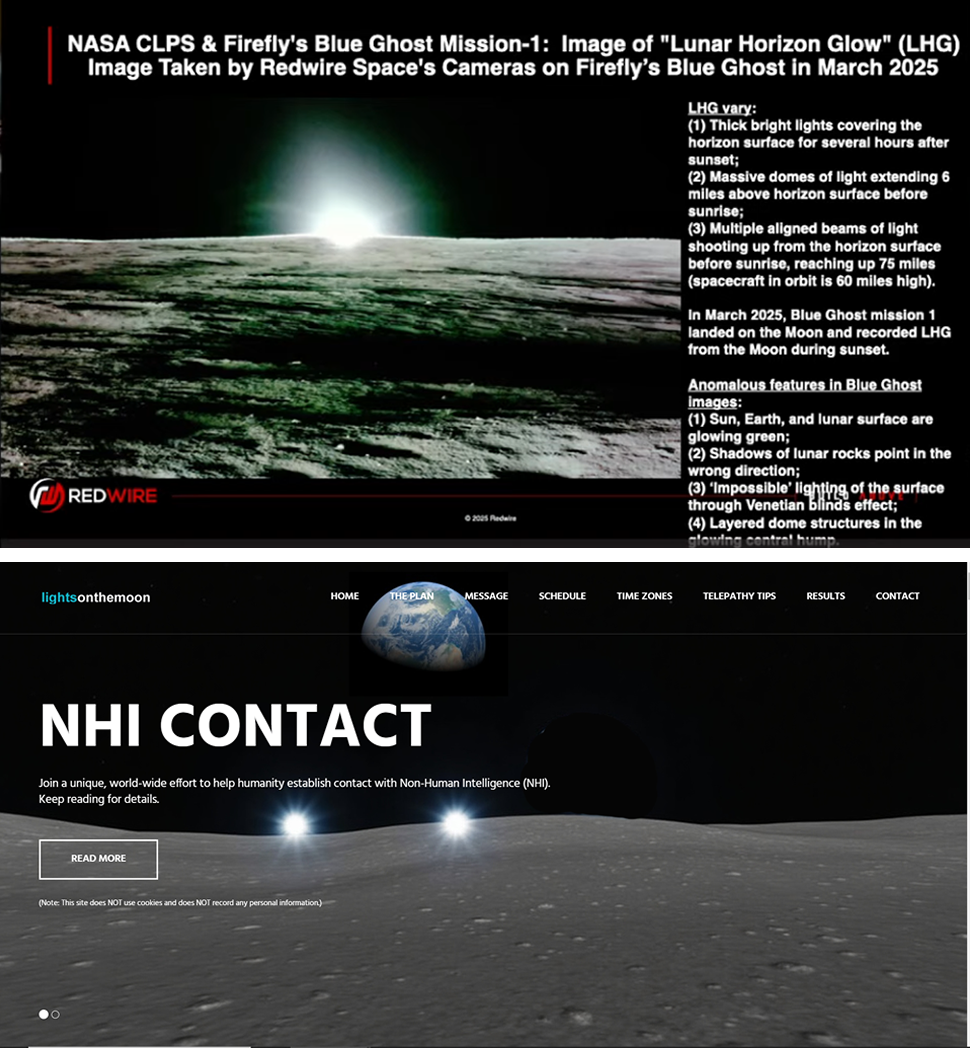
Although Transient Lunar Phenomena (TLP) are different from the prolonged, deliberate display we are asking for, they are worth a closer look. For centuries, observers have reported brief flashes, glows, and color changes on the lunar surface, and professional astronomers have mounted several campaigns to catalog and study them. In 1968 NASA published a "Chronological Catalog of Reported Lunar Events" (Technical Report R-277) that gathered some 579 reports going back to the 1500s. Networks such as the Association of Lunar and Planetary Observers and the British Astronomical Association's Lunar Section have kept up systematic visual monitoring for decades, and in 1992 the French astronomer Audouin Dollfus recorded glows and obscurations near the crater Langrenus from the Observatoire de Paris.
Two modern programs now watch the Moon for sudden impact flashes with automated telescopes. NELIOTA, run by the National Observatory of Athens on the 1.2 meter Kryoneri telescope, has monitored the dark side of the Moon since 2017 and records each flash in two colors, which lets it estimate the temperature of the event. NASA's lunar impact monitoring program at Marshall Space Flight Center has built a candidate catalog of hundreds of flashes since 2005. Both programs observe whenever the Moon's night side is favorably placed, which is the same part of the lunar cycle in which we transmit, and NELIOTA typically publishes new detections within a few days. That matters to us, because these programs would unambiguously document the appearance of exactly the kind of long-duration lights we are asking for.
It is natural to ask what NELIOTA and NASA have actually recorded on our scheduled transmission dates. Our new Transient Lunar Phenomena and Anomalous Lunar Events page walks through this in full, but here is the short version. Several flashes in the NELIOTA archive land remarkably close to a transmission. On November 13, 2025 the telescope caught two separate flashes within a few hours of a transmission, right at the edge of the half moon, and three more transmissions in 2025 and early 2026 each have a flash within about half a day. Taken on their own, hits that precise are eye-catching, since each one has only about a one-in-a-hundred chance of landing that close.
The six recent flashes that first caught our eye
| UT date | UT time | Offset (days) | Illum % | R mag | I mag | R − I (color) | Duration (s) | Lon | Lat | Images (R / I) |
|---|
| 2025-09-14 | 23:56:16 | +0.055 | 49.4 | 8.34 | 7.54 | 0.80 | 0.165 | +72.0 | +6.0 |  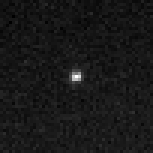 |
| 2025-11-13 | 02:21:24 | +0.095 | 49.0 | 10.86 | 8.81 | 2.05 | 0.066 | +70.0 | +9.0 |  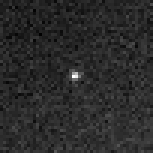 |
| 2025-11-13 | 03:10:06 | +0.129 | 48.6 | 10.04 | 8.47 | 1.57 | 0.099 | +44.0 | −5.0 |  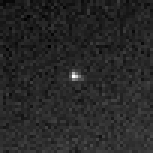 |
| 2025-10-28 | 18:32:01 | −0.466 | 45.1 | 7.58 | 6.33 | 1.25 | 0.066 | −18.0 | −18.0 | 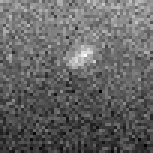 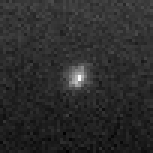 |
| 2025-08-17 | 00:28:48 | +0.608 | 43.5 | 10.25 | 9.24 | 1.01 | 0.066 | +54.6 | −7.9 |  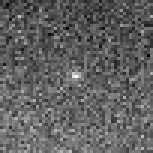 |
| 2026-02-23 | 17:58:20 | −0.612 | 43.5 | 9.55 | 7.21 | 2.34 | 0.099 | −17.5 | +15.4 |  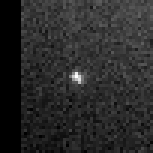 |
Each row is a real NELIOTA detection. Offset is the gap in days between the flash and the nearest transmission, so the closer it sits to zero the tighter the coincidence, and all six fall within about half a day. Illum is how much of the Moon’s face was lit, close to fifty percent because these land at the half moon where we transmit. R and I give the flash’s brightness in two color bands, and the thumbnails are the actual telescope frames. These are the six flashes marked in gold on the TLP page, where you can explore them alongside the full archive of hundreds.
A fair look at the numbers calls for caution, though. The NELIOTA archive holds hundreds of flashes spread across nine years, and we transmit twice a month, so a handful of close coincidences is exactly what ordinary chance produces. When we count every flash within a day of a transmission, the rate (about 14%) matches what random timing alone would give (about 13.5%). The striking individual hits are the expected rare tail of a large dataset, not yet evidence of a pattern.
There are simply too few data points to say whether these coincidences mean anything. To make a scientifically robust statement about any correlation, we would need the telescopes' exposure records (how many hours they watched at each lunar phase, so flashes can be turned into a true rate) and many more transmission cycles to build up the sample. Those are exactly the things that accumulate over time.
All of that aside, it is well worth keeping an eye on the NELIOTA data released around each transmission date. Our TLP page gives you the actual raw observations and a set of simple tools to explore them yourself, so you can watch for new patterns as fresh data arrives. Nearly all of these flashes are attributed to small meteoroids striking the Moon, but in most cases that is an interpretation of the data, not an established fact. We are grateful to Dr. Alexios Liakos of the NELIOTA project, who supports this educational effort and has given his blessing to our use of the NELIOTA data.